
The short answer. Buy Navage if you want a rinse that takes half a minute, you will not bend over a sink, and you are happy to pay for Navage’s own SaltPod capsules for as long as you use it. Buy a neti pot if you want the lowest running cost, no batteries and no capsules, and you are willing to spend a week or two learning the head tilt.
I should say where I stand. We sell a copper neti pot, and jala neti is part of my own practice, so I rinse with a copper pot myself. Everything below about Navage comes from navage.com, its product pages and its help centre, read on 7 November 2026. I have not used a Navage, and I have left out every claim Navage makes about what rinsing does for congestion or allergies; this page compares the devices, their costs and their upkeep.
How a neti pot moves the water
Picture a small teapot with a long spout. You mix saline in lukewarm safe water, lean over a sink, tilt your head so one nostril points up, and rest the spout tip in it. The water finds its own way around the back of the nose and runs out of the lower nostril. Then you blow gently and do the other side.
Nothing pushes the water. The flow is only as fast as the slope you give it, so the first few rinses can feel clumsy. Breathing through the mouth while the water runs is the part that takes practice.
How Navage works
Navage is a handheld device with two tanks. You fill the upper tank with water, drop a SaltPod capsule into a crushing chamber, press two nose pillows into your nostrils and press the power button. Navage describes the route as in one nostril, around the back of the nose, and out the other. A pump creates gentle suction, and the used rinse collects in the lower tank. A cycle ends when the upper tank is empty.
Two rules come with a Navage. It runs only with a new, genuine SaltPod for each rinse; Navage says you cannot mix your own saline in it. And Navage’s product page says the device is FDA-cleared for users 12 and older, and lists people who should not use it: anyone under 12, anyone who cannot breathe through either nostril, and anyone with an ear infection or blocked ears.
The Original Nose Cleaner runs on AA batteries (two come installed in the Starter Bundle). The newer Advanced Nose Cleaner charges over USB-C.
Neti pot vs Navage at a glance
| Neti pot (our copper pot) | Navage Original | |
|---|---|---|
| What moves the water | Gravity | Battery pump, suction |
| Learning curve | The head tilt and mouth-breathing take practice | Navage says it may take a few tries to keep water out of your throat |
| Time per rinse | Depends on you; slower while learning | 20 to 30 seconds for most users (Navage) |
| Salt | Any saline packet, per its directions | SaltPods only, one per rinse |
| Water per rinse | Pot holds 450 ml; about half per side | 230 ml (7.75 oz) per SaltPod |
| Power | None | 2 AA batteries (Original); USB-C (Advanced) |
| Dishwasher | No, hand rinse and dry | No; Navage says it is not dishwasher-safe, and its warranty does not cover dishwasher damage |
| Who can use it | One pot per person | Ages 12 and up |
| Price to start | $52.95, no salt included | $99.95 Starter Bundle with 30 SaltPods |
Prices were read on 7 November 2026 on copperhealer.com and navage.com.
Neti pot vs Navage: cost over a year
The costs separate here. The device price is a one-off; the capsules or packets are not.
For Navage, I used the Starter Bundle at $99.95 (it includes 30 SaltPods) and the Original SaltPod 30-pack at $11.95, or $10.76 on Navage’s subscription. For the neti pot, I used our pot at $52.95 and NeilMed’s Sinus Rinse refill box of 100 packets at $15.99 from NeilMed’s own shop, one packet per rinse. One NeilMed packet makes 240 ml, close to the 230 ml one SaltPod makes, so the two rinses are a fair match.
| One person | Neti pot + packets | Navage, one-time prices | Navage, subscription |
|---|---|---|---|
| Year 1, one rinse a day | $116.91 | $243.35 | $229.07 |
| Year 1, two rinses a day | $180.87 | $386.75 | $358.19 |
| Year 2 on, one a day | $63.96 | $155.35 | $139.88 |
| Year 2 on, two a day | $127.92 | $298.75 | $269.00 |
How the sums work: one rinse a day for a year is 365 rinses. Navage’s 30 starter pods leave 335 to buy, which is 12 packs. A neti pot user buying boxes of 100 needs four boxes for the year.
What the table leaves out. Distilled or boiled water costs the same for both and is not counted. Navage says fresh AA batteries last at least 3 to 4 months at two rinses a day, so a pack or two a year; they are not counted. If you fill our pot to the top each time (450 ml), you use nearly two packets per rinse, and the salt column roughly doubles. Navage also sells Eucalyptus and other flavoured SaltPods at $13.95 a pack, which raise its yearly figure.
Plainly: over a year, a neti pot costs about half as much as Navage at one rinse a day, and the gap widens every year after.
Which to buy
Buy Navage if:
- you want the rinse over in under a minute;
- the head tilt of a neti pot has never worked for you;
- you are fine with buying SaltPods for as long as you use the device, and you are 12 or older.
Buy a neti pot if:
- you want the lowest running cost and no capsules tied to one brand;
- you want a device with no motor, no batteries and no seals to fail;
- you are willing to learn the tilt and the mouth-breathing.
Skip both, and ask a doctor first, if you cannot breathe through either nostril, have an ear infection or blocked ears, or have had ear or nose surgery recently. Navage lists these on its product page.
The water rule is the same for both
The device matters less than the water you put in it. The US Food and Drug Administration’s guidance on neti pots and other rinse devices names distilled water, sterile water, boiled tap water cooled to lukewarm, or water passed through a filter made to trap infectious organisms. For the boil, the CDC says to bring tap water to a rolling boil for 1 minute (3 minutes at elevations above 6,500 feet), then let it cool. If you boil a batch ahead, the FDA says it keeps for 24 hours in a clean, closed container. Straight tap water is out.
Navage gives the same list on its own pages: distilled or sterile bottled water, boiled and cooled water, or water micro-filtered to 0.2 microns. It adds that the water should be lukewarm and no hotter than about 90°F (32°C). Our copper pot’s page says the same about water, and that each pot is for one person only.
Cleaning and upkeep
Navage. Navage asks you to clean it after each use. The upper and lower tanks come off and are hand-washed with liquid soap. The white mechanical module is not waterproof, so it is wiped with a damp, soapy cloth and never rinsed under the tap. A small scrubber comes with it for the drain pipes, nose pillows and nasal dock, and the crushing-chamber lid needs hot water to melt dried salt. The parts should dry fully between uses. Navage’s warranty page gives its Nose Cleaner two years on parts and labour, extended for as long as you keep a SaltPod subscription. It does not cover dishwasher damage, soaking the device in water, or use without a genuine, unused SaltPod.
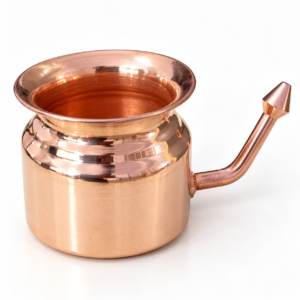
A copper neti pot. Ours has one part. After each rinse, tip it out, rinse with clean water, then dry the inside and outside completely. Store it dry. Wash it by hand. Half a lemon pressed into salt and rubbed over the metal brings the shine back, followed by a rinse and a dry.
The difference is mostly time. Navage has more parts to separate and dry. The copper pot asks for one habit: dry it every time.
Why I rinse with a copper neti pot
Jala neti is part of my own practice, next to the yoga, meditation and Agnihotra fire ritual I have kept up for years, and the pot I use is copper. Our pots come from coppersmiths in India I work with directly. At their workshop I check the sheet copper before it is shaped, and finished pieces pass through my hands before orders are packed.
Our Copper Neti Pot is pure copper with no lacquer or coating inside, polished smooth, and handmade in India. Capacity is 450 ml, roughly 15 fl oz; it weighs 250 g, and the store lists it at 9 × 9 × 15 cm. You can fill it from a jug through the flared lip, and the angled spout narrows to a cone tip for the nostril. It comes as one pot, without salt, at $52.95, and six customers have rated it 5 out of 5.
Where it loses to Navage, honestly:
- It leaves the flow to your head angle. Navage’s pump does that work for you, though Navage says its own device can take a few tries too.
- It ships from India. Orders leave after 1 to 4 business days of processing, and transit to the US is estimated at 10 to 15 business days, with free standard shipping.
- Navage offers 30-day returns on purchases from navage.com, so you can try it in use (you pay the return shipping, and opened SaltPod packs are not refunded). Our pot comes with 30-day returns (see our Returns policy).
Don’t buy our pot if you need a rinse in under a minute, or you want to try a device in use and send it back if it does not suit you.
Neti pot vs Navage: questions people ask
Is Navage better than a neti pot?
Navage is faster and easier to start with, and it costs more to run. A neti pot is cheaper over any length of time and has nothing to break or charge. Which is better depends on whether speed or running cost matters more to you.
Can I use my own salt in a Navage?
Navage says the device needs a new, unused SaltPod in its crushing chamber for each rinse, and the device will not start without one.
Can I use tap water in either one?
Use distilled, sterile, or boiled-then-cooled water in either one; untreated tap water is ruled out by the FDA, by Navage and by our pot page alike.
How long does a rinse take?
Navage says most of its cycles last 20 to 30 seconds, and anywhere from about 10 seconds to a minute. A neti pot rinse takes as long as the water takes to flow out by gravity, which is slower at first and quicker once you have the angle.
Can children use Navage or a neti pot?
Navage says its Nose Cleaner is not for children under 12. The FDA notes that children as young as 2 might use a rinsing device if their pediatrician advises it, though the youngest may not put up with it. Ask your child’s doctor first.
Can two people share one?
Navage says the best practice is one device per person, and sells a separate nasal dock and nose pillow combo for households that share. Our pot page says one pot per person.
For neti pot vs Navage, my own answer is the pot: lower cost every year and nothing to charge. If speed matters more than cost, Navage is the one to try. If you choose the pot, ours is the pure copper neti pot I use for my own rinse.
Sources, read 7 November 2026: navage.com (Starter Bundle, Original SaltPod 30-pack and Advanced Nose Cleaner product pages; Navage help centre answers on water, cycle length, SaltPods, cleaning, warranty and the 30-day guarantee); FDA, “Is Rinsing Your Sinuses With Neti Pots Safe?” (content current as of 28 April 2025); CDC, “How to Safely Rinse Sinuses” (dated 16 July 2025, read 12 November 2026); NeilMed shop, Sinus Rinse 100 regular premixed packets; copperhealer.com Copper Neti Pot page.